
Every RPA vendor is adding orchestration to its product line this year. Every major AI platform is doing the same thing from the other direction. UiPath has Maestro. Blue Prism has WorkHQ. The large application suites are building agent orchestration straight into their existing stacks. On the surface this looks like progress, automation growing up, getting more joined up.
Look closer and the picture is more interesting than a simple walled garden story. UiPath markets Maestro as vendor neutral, able to call out to third-party agents on Databricks, Snowflake Cortex, Azure AI Foundry, and CrewAI through its own connectors, and to coordinate UiPath robots, third-party agents, and people inside a single process. Blue Prism’s WorkHQ makes a similar claim, routing work across humans, systems, automations, and outside AI services. Neither vendor is hiding behind a closed platform anymore. Both can genuinely reach beyond their own robots.
The Connector Illusion: Connectivity Isn’t Neutrality
What neither can do is orchestrate without owning the orchestration.
Every one of those third-party connections still runs through a control plane that UiPath or Blue Prism built, licenses, and logs. The routing decision, which agent handles a task, when something fails over, what gets flagged for a human, is made inside a system whose commercial interest is keeping your workflow logic, your automation spend, and your governance data inside that platform.
Calling out to a Databricks agent through a connector isn’t the same as running that decision through a layer with no stake in which tool wins.
Gartner’s own assessment of the category makes the same point more bluntly: most agentic orchestration offerings in the market are still limited to a single vendor’s development environment, whatever the marketing around openness claims.
Enter the Universal Orchestrator
Gartner’s July 2026 Hype Cycle for Agentic Automation gives the alternative a name: the universal orchestrator, a vendor-neutral abstraction layer that coordinates and governs AI agents, bots, APIs, and human activity across multiple platforms, decoupling orchestration logic from the execution layer underneath it.
Gartner rates it:
- Transformational in business impact.
- Embryonic (5% to 20% penetration), with no single vendor yet delivering it in full.
Both are true at once. The need is real. The market built to answer it is still forming.
How Automation Estates Actually Get Built
The need is real because of how automation estates actually get built. Nobody sits down and designs a five-vendor stack on purpose:
- Three years ago: One business unit picked an RPA platform.
- Last year: Another built agents on a different model provider.
- Today: A third is running workflow automation through a SaaS tool nobody in IT signed off on.
Add AI agents into that mix and the sprawl compounds fast. Gartner puts a number on where this is heading: by 2030, 60% of organisations will adopt platforms for AI agent orchestration from vendors outside their existing systems of record providers. Most enterprises will end up needing an orchestration layer that none of their incumbent platform vendors can honestly provide, connectors or not.
What a Genuinely Neutral Control Plane Must Do
So what does a genuinely neutral control plane need to do differently?
- Sit above, not inside: It has to sit above the execution platforms, not inside one of them, with its own commercial interest in nothing except the outcome.
- Treat all workers equally: It has to treat RPA bots, AI agents, APIs, and human workflow steps as different kinds of workers doing the same job, getting work done against a deadline, a priority, and a cost.
- Remain objective: It needs to be honest when a task would run better, or cheaper, on a rival’s tool.
- Deliver unified visibility: It needs visibility across every platform at once, not a dashboard per vendor that someone stitches together by hand every Monday.
That’s the part a vendor-owned orchestration layer structurally cannot do, no matter how many connectors it ships. It can route work outward. It can’t recommend against itself.
The Regulatory Imperative
None of this is theoretical for regulated industries. Under frameworks like DORA, the operational resilience of an automated process is the enterprise’s responsibility, not the vendor’s, regardless of which platform is doing the work or how many other tools it happens to connect to.
A bank can’t tell its regulator it lacks visibility into a process because that visibility sits inside a vendor’s control plane. The governance obligation sits with the enterprise. The tooling to meet it has to sit there too.
The Architecture Decision is Open Now
The organisations getting ahead of this aren’t waiting for one dominant orchestration platform to emerge and consolidate the market. They’re building the habit of independence now, while the multi-vendor stack is still young enough to govern properly.
That means:
- Asking, of every automation and AI purchase, who owns the layer deciding what runs where, and whether that layer has anything to gain from the answer.
- Accepting that standardising on a single agent platform isn’t realistic, every team will pick a different one regardless.
The real question is who builds the layer that sits above all of them, with nothing underneath it to protect.
Category immaturity cuts both ways here. There’s no off-the-shelf answer yet, but the architecture decision is still open. Enterprises that wait for the market to consolidate before deciding who owns their control plane will find the decision has already been made for them, by whichever vendor’s connectors reached the most systems first, and lose the control they actually need.
Discuss the Future of the Control Plane Live in London
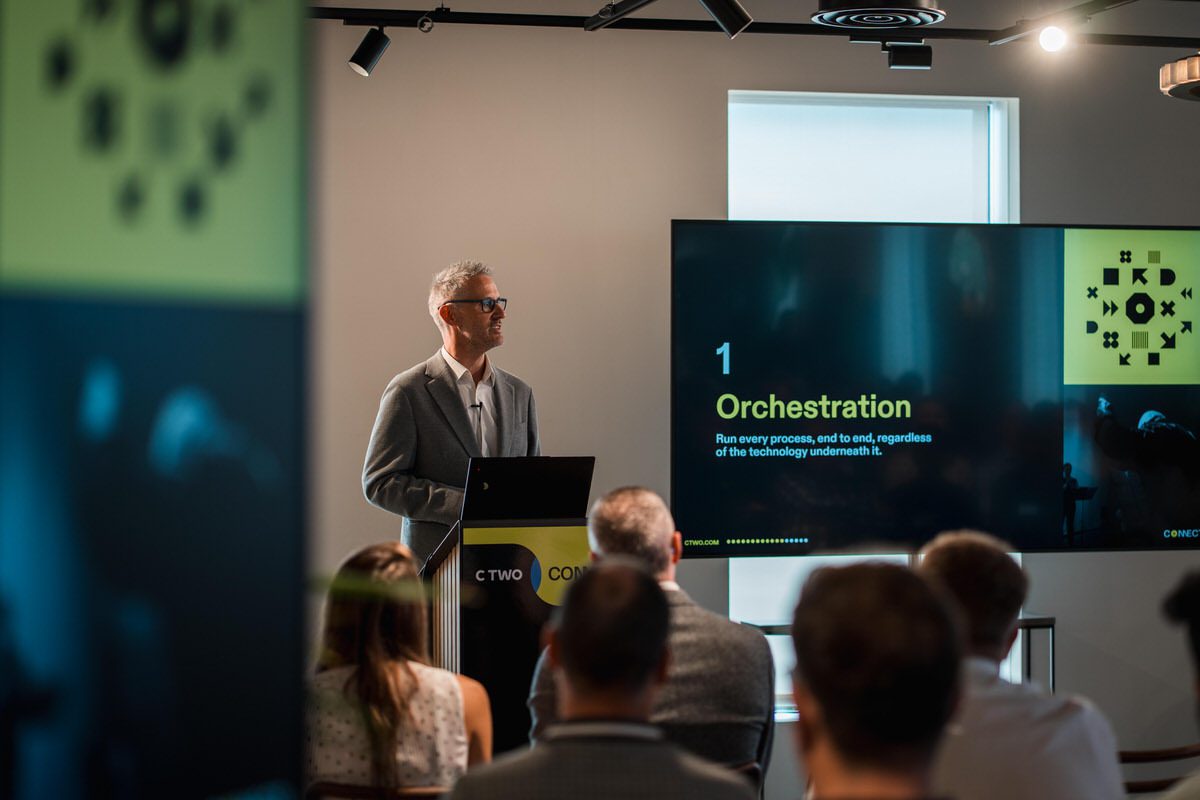
If you are wrestling with agent sprawl, token costs, and multi-vendor governance, join us at C TWO Connect on 15 October 2026 in central London.
You’ll hear directly from enterprise automation leaders at Lloyds Banking Group, Commerzbank, and E.ON on how they are building an independent control plane above their existing vendors, and see live demonstrations of C TWO’s Universal Orchestration and new Intelligence layer in action.
Places are limited for end users of automation and AI technology.