
Two words get used interchangeably in automation, and the difference between them is the whole argument. So it is worth being precise.
Execution is the work the underlying systems perform. Updating a record. Sending a communication. Applying a rule. Showing a screen to a person. Running an inference.
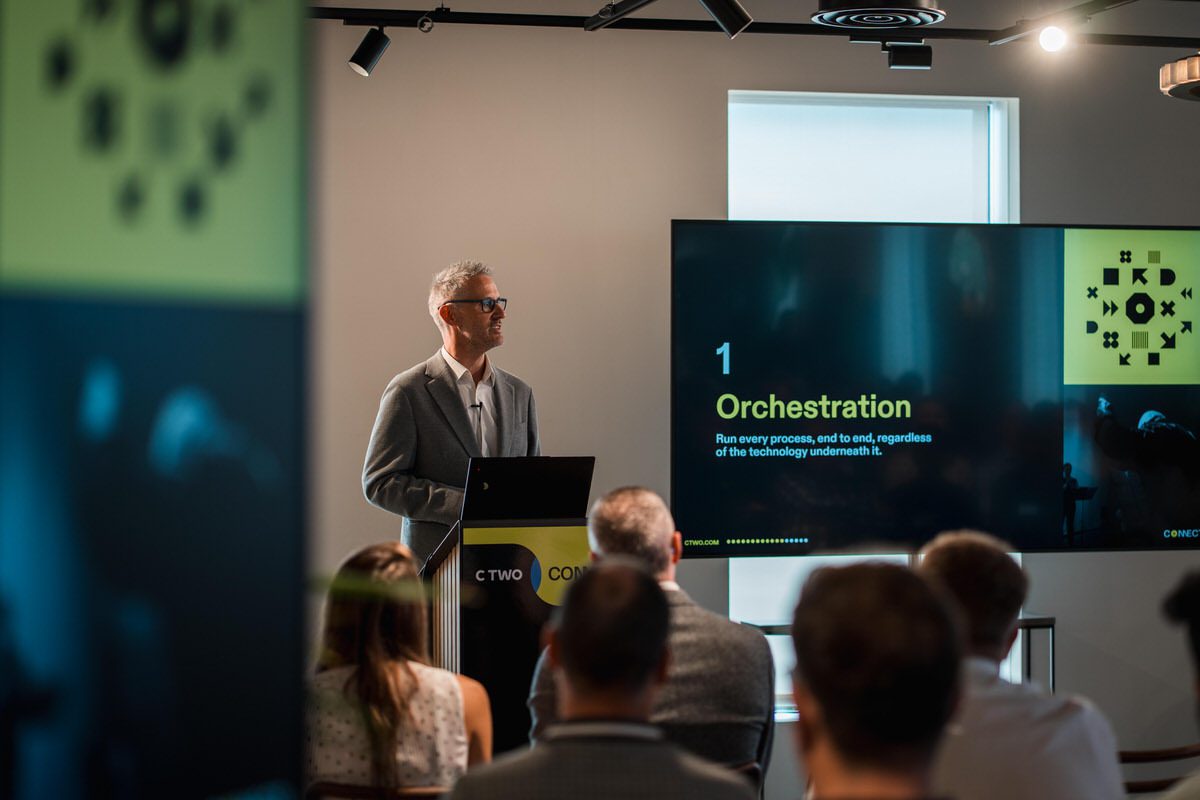
Orchestration is the coordination logic that decides how the work fits together. What runs, in what order, who or what should do it, what happens when something fails, when a human needs to be brought in, and which policies apply throughout. Gartner draws the line clearly, describing orchestration as the sequencing, state management, retries, escalation, and policy enforcement that sit across agents, bots, APIs, and humans.
Universal orchestration is that coordination logic raised to the level of the whole estate rather than a single platform. Gartner defines the universal orchestrator as a set of capabilities for orchestrating and governing multivendor AI agents, bots, and human activities within a business process. They are careful to call it an emerging pattern rather than a finished market. No single vendor delivers the complete picture yet, and several are converging on it from different starting points.
The contrast with the orchestration most enterprises run today is stark, because traditional BPM and scheduler-based systems were built for a world that no longer exists.
- Traditional scheduling follows static, rule-based flows; universal orchestration adapts in real time to live context.
- Traditional is tied to a single vendor or toolkit; universal works across platforms and vendors.
- Traditional stops when an exception occurs; universal recovers and reroutes automatically.
- Traditional brings humans in only after failure; universal brings them in by design, with context.
- Traditional is predictable but brittle under change; universal is flexible and driven by outcomes.
The most useful way to think about it is as an operating system for your automation estate. An operating system does not do the work itself. It coordinates everything that does, manages the resources they share, and hides the underlying complexity so the whole thing behaves like one reliable system. Universal orchestration plays that role across bots, agents, APIs, and people.
What a universal orchestrator has to do
Gartner groups the capabilities into three areas, and it is a useful frame because it separates what the layer coordinates from how it remembers and how it stays governed.
Coordinating agents, bots, and people in real time. The orchestrator routes and prioritises work across humans, bots, and AI agents, deciding dynamically based on current inputs, system state, and business context. It works out what should happen next, who is best placed to do it, and whether work should proceed, pause, or escalate. It operates at the level of the individual work item rather than the batch, because at enterprise scale the question is always which specific items are at risk, which depend on others, and which can move in parallel. When something fails, it detects the failure and recovers, retrying or rerouting without waiting for a person to notice. When a person genuinely is needed, the escalation is deliberate and arrives with full context before an SLA is breached, not after.
Holding state, context, and memory across the whole process. Long running processes using multiple actors or technologies need to hold state consistently at the orchestration layer. Not inside individual tools or disconnected specialist orchestration layers. Keeping process state, routing logic, and data context in one place gives a reliable view of all in-flight work across every tool — without forcing standardisation across your stack.
Governing and observing everything that runs. If you cannot see it, you cannot trust it, and at enterprise scale you cannot govern what you cannot see consistently. The orchestrator provides end-to-end visibility into every process, actor, and outcome, enforces policy across all of them, and logs every action so it is auditable by default. Human-in-the-loop control, SLA enforcement, and compliance escalation all belong here. Gartner treats human oversight as mandatory wherever AI agents introduce probabilistic behaviour or regulatory risk, and draws a sharp distinction between governance built into the layer and governance bolted on through integrations after the fact.
Why this matters now
Most enterprises reach the point of needing this precisely because they have succeeded at automating. They have done enough to expose the cracks in how it all fits together. The thing that holds it together from here is not another execution tool. It is orchestration.
There are two honest ways in. Many organisations start with the immediate, measurable problem of an estate that costs too much and breaks too often, and a coordination layer delivers there quickly by reclaiming licence capacity, lifting utilisation, and holding SLAs. That same layer is what carries them into coordinating agents and multi-vendor automation as the estate grows.
The work you do to optimise today is the foundation you orchestrate on tomorrow. The most useful first move is to look honestly at the estate you already run, and the costs you can already measure, and start there.
C TWO is the independent orchestration layer for enterprise automation. Optimise today. Orchestrate tomorrow.