
Every major automation vendor is moving up the stack.
They’ve been doing it for a couple of years now, but the pace has accelerated. Orchestration capabilities added to execution platforms. Governance features bundled into licensing agreements. Analytics dashboards that only show you data from their own tools.
They’re calling it integration. And on the surface, it looks convenient. One vendor, one platform, orchestration included. Fewer procurement headaches. Simpler architecture. Except that’s not what’s actually happening.
What’s happening is that your governance layer, your cost visibility, your workflow routing decisions, and your performance analytics are all living inside the same platform that sells you execution licences. The same vendor that benefits commercially when you buy more bots or agents is now the one telling you how well they’re performing and whether you need more of them. That’s a conflict of interest dressed up as a feature.
And it’s worth being honest about why this matters. Because most enterprises aren’t running a single automation vendor anymore. They haven’t been for a while. Two RPA platforms across different regions or business units are common. Three isn’t unusual. Add AI agents from a different set of providers, API integrations, Power Automate flows, and the occasional human-in-the-loop workflow, and you’ve got a stack that no single vendor can see the full picture of.
So when one of those vendors offers to orchestrate everything, ask yourself: orchestrate everything, or orchestrate everything, as long as it runs on their platform? There’s a meaningful difference.
A global insurer came to us running two of the top three vendors across different regions. Neither platform could give them a unified view of cost, performance, or utilisation. Each had its own dashboards, its own metrics, its own version of the truth. We sat above both. One control plane. One set of governance policies. One place to see what was actually working and route work accordingly.
That independence isn’t something a platform vendor can offer. Their view will always favour their own tools. Not because they’re dishonest, but because their commercial model requires it.
Gartner has been watching this dynamic closely. Their research on universal orchestration makes the case that enterprises deploying AI agents across multiple vendors and platforms will increasingly need a dedicated orchestration layer, one that’s independent of the execution technologies underneath. Their prediction: 90% of enterprises in this position will need an abstracted universal orchestrator by 2029.
The reason is structural. As AI agents move from experimentation into production, orchestration becomes the primary constraint on safe, compliant, repeatable outcomes. And that orchestration can’t credibly come from the same vendors whose commercial incentive is to keep you inside their stack.
This is the architecture question that enterprise technology leaders are going to have to answer. Some are already answering it.
E.ON made a deliberate choice to bring in an independent orchestration layer rather than rely on their existing platform vendors for governance and visibility. The results were measurable: 99% SLA adherence and 25% reduction in total cost of ownership. But the strategic value went beyond those numbers. They now have a single view across their entire automation estate, with governance that isn’t tied to any one vendor’s roadmap.
The enterprises getting this right are treating orchestration as an independent architectural decision. They’re buying the ability to mix tools, swap tools, and govern everything from one place, regardless of which vendor built the bots.
The ones who wait are going to find that the choice gets made for them. Because every quarter that passes, the vendors integrate a little deeper. The switching costs get a little higher. And the window for architectural independence gets a little narrower.
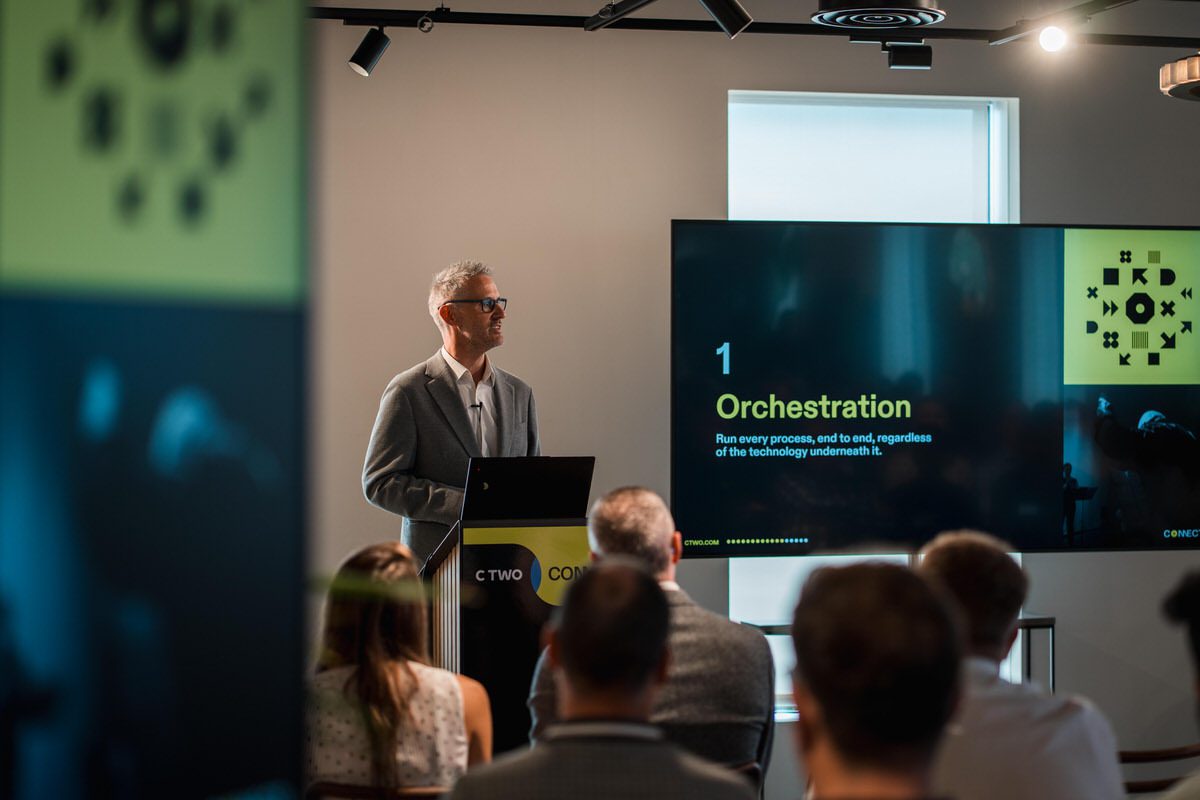
We built C TWO on a simple assumption: the orchestration layer should outlive any single vendor choice. We don’t sell bots. We don’t sell agents. We don’t compete with your existing platforms. We sit above everything for unified orchestration, governance and visibility.
That independence isn’t a limitation. For the 170+ enterprises we work with across 14 countries, it’s the point.